

Mineshaft: A Jockey Club Gold Cup win that cemented a championship season
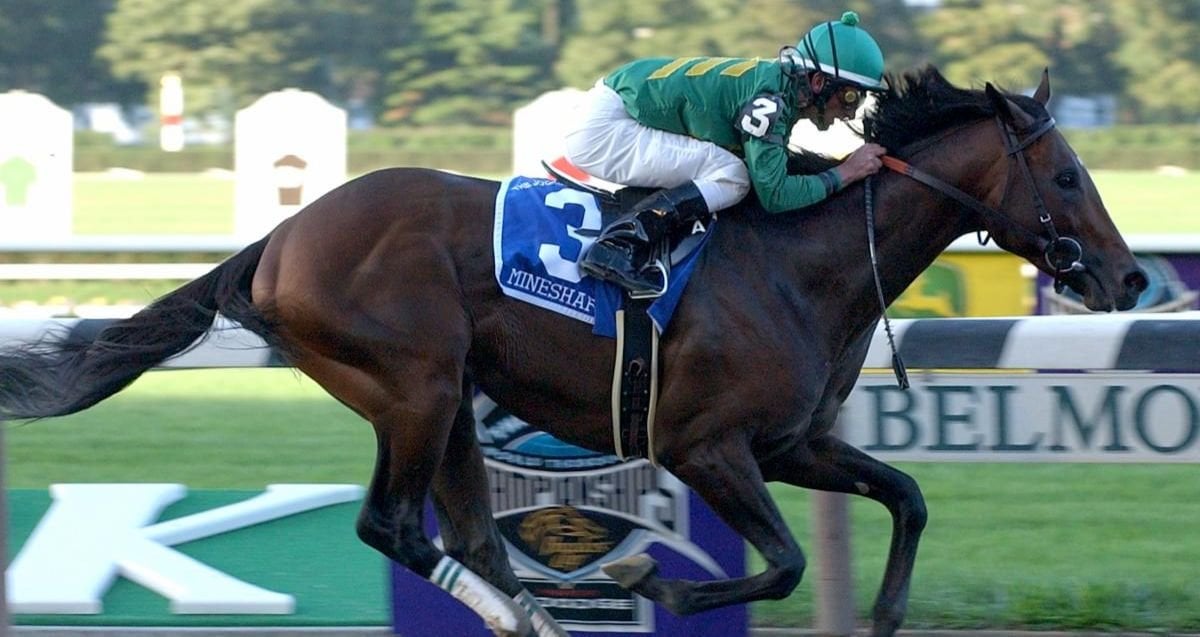
The race hadn’t even started but the whistles and cheers were already ringing in trainer Neil Howard’s ears.
The crowd that had shown up to Belmont Park was a savvy one, especially those zeroing in on the slate of top-level stakes that made up the Breeders’ Cup preview days of old. They knew to anticipate when something special was about to transpire. And so, as they watched the post parade for the 2003 edition of the Grade 1, $1 million Jockey Club Gold Cup, the 10-furlong proving ground that had long served to anoint a divisional king, they let their appreciation for the top older horse in the country be known, providing a rousing soundtrack for Mineshaft as he completed his preparations before the grandstand.
“That particular day when people were cheering him when they were finishing warming up, I looked at my wife at first and the feeling I got…it was hard to describe how we felt when people were clapping and whistling for him,” the venerable Howard recalled of the moments before one of the best horses he ever conditioned went to post for what would be the final start of his career. “It was like [golfer] Scottie Scheffler or one of these guys walking up to the 18th green getting ready to win the Masters. It really resonated with me.”
If the sounds of admiration were amplified before the gates were sprung, they reached a crescendo when the subject of their affection hit the top of the stretch and confirmed an ovation-worthy performance would be delivered. Where his nearest rival, Quest, was on his belly in a vain attempt to keep pace, Mineshaft only felt a nudge from his astute pilot Robby Albarado as his stride lengthened and more daylight was put between him and challengers. He would be hand ridden across the wire, finishing 4 1/4-lengths in front.
“Routinely brilliant,” boomed the unmistakable timbre of track announcer Tom Durkin.
It was a declaration that could qualify as a summation of what Mineshaft achieved each time he set foot upon the Belmont oval.
There was indeed ample brilliance to be found in the seven victory, nine-start campaign Mineshaft crafted in 2003 that would earn him Eclipse Award honors for Horse of the Year and Champion Older Horse. Having started his career with modest efforts on the turf in Europe under the heady guidance of trainer John Gosden, the son of the legendary A.P. Indy had been shifted to the Howard barn the previous fall and found life on the North American dirt to be the ideal conduit for the generational talent coursing through his veins.
His was a progression that began innocently enough with a season-opening nose victory in a stake at Fair Grounds that January, his third consecutive win since coming stateside. By the time the eyes of the racing world had shifted its focus to Belmont Park for its 2003 fall meet, there wasn’t much room for debate in conversations about who bore the biggest target in the handicap ranks.
The Elmont, New York faithful had already witnessed Mineshaft dispatch of the reigning Grade 1 Breeders’ Cup Classic winner Volponi by 2 1/4-lengths in the Grade 1 Suburban Handicap that July. Following a two-month freshening, the blue-blooded specimen owned and bred by William S. Farish – founder and owner of Lane’s End Farm - James Elkins, Jr. and W. T. Webber, Jr. hit the cruise control once more when notching a 4 1/4-length triumph in the Grade 1 Woodward that September.
If there is a downside to having an equine athlete capable of rendering attempted challenges moot, it’s the burden of expectation that can come from those settling in to witness what they believe is a foregone conclusion. Even the most superior talents can be felled by race circumstance. Yet, the aura Mineshaft created was one that allowed his inner circle to exhale even under the crush of pressure from his 2-5 race favoritism.
“With a horse like Mineshaft…you knew that with his running style, he controlled the race with his speed. You just felt like he was going to win,” said Bill Farish, who has helmed Lane’s End alongside his father. “He didn’t win every time, but he certainly was very consistent. I just didn’t have that same feeling of relief that you normally would when you’re favored in a big race. I felt like something really weird was going to have to happen for him to not win the Jockey Club Gold Cup.”
What the 4-year-old Mineshaft was blissfully oblivious to was the fact he indeed had to shoulder more than just the 126 pounds on his back for the 85th running of the Jockey Club Gold Cup.
The 1 1/4-mile test had the distinction of being one of prizes coveted most by Will Farish and one that had eluded the Lane’s End trophy case to that point. It was a particularly stinging omission given the fact Mineshaft’s sire, the Hall of Famer and breed-shaping force that was A.P. Indy, could only manage third in the race during his 1992 Horse of the Year campaign.
Hence, when Mineshaft joined Howard’s barn the previous winter after making his first seven starts in Europe, a future run in the Jockey Club Gold Cup was eventually circled in bold ink on the calendar. Racing gods often make a game out of throwing wrenches into long-term plans. But having compiled eight wins from 10 North American starts heading into his final test, Mineshaft had shown he was not one to let obstacles thwart his path.
“I think the Jockey Club Gold Cup to a traditionalist - which we all are - that used to be the Breeders’ Cup Classic. That was the race you had to win to be Champion Older Horse and Horse of the Year,” Bill Farish said. “All those championships kind of went through New York in the fall. It was that kind of prestige, I think. I think that, along with his association with The Jockey Club for so many years and everything else, it was that classic older horse race that my dad always wanted to win.”
From the moment he stepped off the van and into Howard’s Churchill Downs shedrow in late 2002, Mineshaft made it a point to make the arduous seem effortless. He was an unbothered sort, signifying his class in mundane moments like the aftermath of his international flight and stint in quarantine and under unnerving conditions like the near tropical storm he cantered through while capturing the 2003 Grade 1 Pimlico Special Handicap.
As part of his due diligence and desire to do right by the colt entrusted to him, Howard had peppered Gosden with queries on how best he should handle the full brother to Tomisue’s Delight, winner of the 1997 Grade 1 Ruffian Handicap and 1998 Grade 1 Personal Ensign Handicap. From one top horseman to another, Gosden kept it simple - and urged his comrade to do the same.
“It was funny because I remember [Gosden] laughing in a conversation because I was a little bit on edge about a horse coming in of that caliber,” Howard said. “I was talking to John once I got [Mineshaft] letting him know the horse arrived safely from his travels. I was asking John all these questions and John said, ‘Just train him.’ That’s all he kept saying, he started laughing and said, ‘Good luck, just train him.’ And he was right.
“He walked in that barn and went into that stall, he made one turn…and I’m telling you, he never put a foot wrong,” he continued. “When we started going to the track a day later…the way he jogged and galloped, just bowed that neck and went around there and never looked at anything, you knew. He had a mind where he acted like a person, he was that smart. He was bred about as deep as a horse can be bred but he had the physical attributes to go with it, and he had the mind to go with it.”
The entry box for the 2003 Jockey Club Gold Cup attracted a compact field of five, but it was no slam dunk on paper for Howard’s star trainee. Godolphin’s Moon Ballad had annexed the Group 1 Dubai World Cup that March and defending race winner Evening Attire was back at the site of his biggest success.
Once the running began, however, it didn’t take long for the reality of what was to come to sink in. As longshot Quest battled with Moon Ballad through early fractions of 24.08 and 47.73, Albarado had Mineshaft confidently rolling along in third with a gap of nearly eight lengths back to the trailing two. With five furlongs to go, Albarado maneuvered Mineshaft up on the outside so he could look Quest in the eye and ask him, man to man, just how brave that one wanted to be in his upset bid.
“Every time I ride him, I think that there can't be any more. And in every race, there is more and more and more,” the recently departed Albarado told reporters after the race.
Try as he could to provide a response, Quest had no answer when Mineshaft strode out under his own power around the final turn and let the coronation commence. A mild tap from Albarado was delivered midstretch simply to keep his mount’s mind engaged. By that point, Howard’s ears were ringing once more as his charge entered the rarified air of becoming the first horse since Kelso in 1961 to win the Suburban, Woodward, and Jockey Club Gold Cup in the same year.
“He just did everything like a good horse does,” Howard said. “I’m sure Bill Mott will tell you the same thing about [2025 Horse of the Year and 2026 Whitney Stakes winner] Sovereignty. Those good horses, they’re a little bit different. They breathe a little bit different air, they think a little different, it’s like a professional ball player. It was a great story and my wife and I will always be so thankful to be entrusted with him.”
There would be no encore effort for Mineshaft as he would be retired in early October following the discovery of a small ankle chip. When he began his second career alongside his esteemed father in the Lane’s End stud barn, expectations were heavy once more as he commanded an advertised fee of $100,000 his initial season.
Faced with the impossible task of literally living in his sire’s shadow, Mineshaft nonetheless carved out a thoroughly useful reputation in the breeding shed as he was represented by such Grade 1 winners as Effinex, It’s Tricky, True Timber, Dialed In, Discreetly Mine and Weep No More.
In 2024, one year before he would be pensioned from stud duty, Mineshaft enjoyed another pinnacle when he finished third on the general sire list behind heavy hitters Into Mischief and Gun Runner thanks to his son and current Lane’s End stallion, Senor Buscador, capturing the $20 million Group 1 Saudi Cup that season. At the age of 27, he still flaunts looks that leave visitors to the Versailles, Kentucky farm doing double takes at the year of his birth, still inspiring murmurs from an appreciative audience that recognizes the exceptional being before them.
“When you have a horse that is that good and that consistent…you don’t ever have to make any excuses for them,” Bill Farish said. “He just had that high cruising speed, and he could just run his race to where nobody could stay with him. He’s been a very effective stallion and a very good broodmare sire, which doesn’t totally surprise you because he had so much pedigree and so much talent. He was a very useful stallion and the fact he was able to live out his whole stud career here was really great.”
*
This year's renewal of the Jockey Club Gold Cup headlines the Friday, September 18 card to mark the return to racing following a three-year project to transform Belmont Park into a world-class sports and entertainment destination. The 10-furlong route for 3-year-olds and up is slated as Race 5 on the nine-race program, and provides a “Win and You’re In” berth for the Grade 1 Breeders’ Cup Classic in October at Keeneland. First post is 1:30 p.m. Eastern.
To help unveil the new Belmont Park to a national audience on September 18, FOX will present live coverage of the Jockey Club Gold Cup as part of its Belmont Park Returns telecast to air from 3-4:30 p.m. Eastern. For the full broadcast schedule, visit https://www.nyra.com/belmont/racing/tv-schedule/.
